
Say It Out Loud
Is it better to speak or to die?

Swallow it down, keep it to yourself. The words, once spoken aloud, will make the moment lose its shine. This deer-eyed moment, the one at the edge of the garden, will bolt if you startle it. Do not name it. Do not look directly at it. There are things that cannot bear witness. Don’t let your happiness become so legible. Some moments are only themselves in the dark, and you have stumbled into one, and the light above the table is enough, and your love for these people is enough, and you do not need to say so. Stay opaque, refuse the naming of the thing. Better to keep it to yourself for now.

There is a shame that lives in my throat when I want to say the warm thing out loud. The words are always there but the shame is there often too, and it rises, fast and hot, just behind the breastbone, and I have to push it down with the breath I am about to use to speak. The first three times I told a partner I loved them, I had to push something down in my throat to do it. And each time, I said it anyway, just feeling vaguely embarrassed and mildly amused at my own verbal constipation. It was not just the I love yous though. It was every time I told tell a friend that I was glad they had come, that I had had a good time.
In Dutch, my native language, there is a very specific word you would use to tell a friend that you had had a lovely evening with them. The word is gezellig. It does not translate. The Germans have gemütlich, the Danes have hygge, but neither one means quite what gezellig means, and the Dutch will tell you so without being asked of course. English speakers often translate it as cozy, but that is wrong, or at least incomplete. Cozy is a blanket and a book. Gezellig is a blanket and a book and somebody else on the other end of the couch. The word sort of requires company. You cannot be gezellig by yourself. A room can be gezellig, yes, but only when it’s the kind of room that invites people to be and stay in it. A café can be gezellig because of its warmth and its lighting but it would be incomplete without the murmur of other tables. An evening can be gezellig because of who is in it. The word is essentially relational. It is the texture of being together, named.
Gezellig is also, almost always, a word said in the past tense. After hanging out with a friend, it’s not uncommon to text them that the time you spent together was gezellig. Same after leaving a party. You say it on the walk home, or in the text the next morning, or weeks later when somebody brings up the evening again . You say it after, because saying it during would maybe feel a bit strange. To call a moment gezellig from inside the moment is to step slightly outside of it.
In my house, growing up, we fought. We fought freely and we did not hold back, perhaps because we all knew, underneath, that we loved each other and that the love was not in question. But sometimes, on certain nights, we would have what I now think of as a gezellige night. My father would put on Tom Waits and none of us would complain. The board games would come out and we would play my brother’s favorite one, the one we had already played a thousand times. I would sing along to the music and nobody would tell me to shush. Only the light above the table would be on, and the rest of the house would go dark. And the four of us would be, briefly and without effort, at peace with each other.
There was always a moment in those evenings when my mother would catch the warmth of the room in her own chest and be unable to contain it. You could feel it coming. She would put down her playing piece, or her glass, and she would settle back in her chair, and she would sigh a small contented sigh. And then she would say it. Wat is dit gezellig. How gezellig this is. The spell, of course, would break.
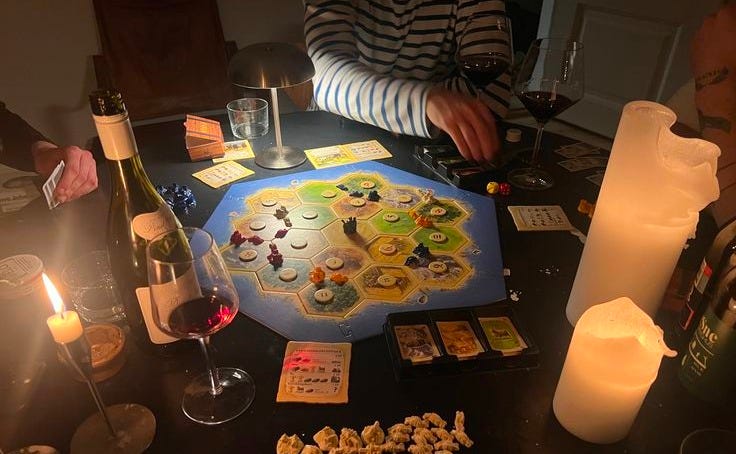
My brother would roll his eyes, or my father would make some small dismissive sound, or I would feel a hot, contrarian shame rise in my chest and I couldn’t help but to complain. To ask aloud why she had to say it. The three of us, without ever discussing it, had become my mother’s quiet adversaries every time she dared to name a moment from inside it. We were the keepers of an unspoken rule we could not have articulated if you had asked us. Gezellig is a past-tense word. You do not say it from inside the room. I don’t think any of us knew we were enforcing it, but enforce it we did.
There is a story in the Heptaméron, the sixteenth-century collection of tales by Marguerite de Navarre, that I keep thinking about when I think about my mother. In one of the tales, a knight is in love with a princess. They are close, but he is too undone by his love to be able to tell her plainly what he feels. He stands at a window one day, in her company, and instead of declaring his love directly, because he cannot, he asks her a question. Is it better to speak or to die. He is asking her, on behalf of himself, what to do. The princess, in the story, tells him to speak. Better to speak, she says, than to die.
What I have only recently come to see is that my mother was the knight. She had been asking the question, every gezellige night of my childhood. Is it better to speak or to die. She had decided, somewhere, against the rest of us, despite the rule we did not know we were enforcing, that it was better to speak. And we had decided, somewhere, that it was better that she had not. We had told her so, every time, with our eyes and our shoulders and, in my case, with my actual voice. Yet, she always said it; she refused to take warmth with embarrassment.
My mother, my sweet mama. A woman shamelessly herself. Who knows what the word cringe is but decided that it only applies when you let it. A woman who I have seen bust out dance moves in the middle of the supermarket aisle while I tried my hardest to blend in with the pasta section. A woman who, every gezellige night of my childhood, looked around the table at the four of us and said the warm thing out loud, even though she could see us flinch, even though she had been seeing us flinch for years, even though she knew exactly what was coming.
You were the one who said the warm thing out loud when the rest of us could not, who named the evening from inside the evening, who looked around the table at your husband and your son and your difficult daughter and decided, every single time, that the risk of saying it was smaller than the risk of letting it pass. We, rolling our eyes, the ones who flinched, who felt the hot shame rise as if your tenderness were a thing to be embarrassed by, we were the coward at the table. Now, more than a decade later, I wish to sit at that same table as you and have you say how gezellig it all is.
So say it, mama. Say it out loud. Sigh your small contented sigh. Tell us how gezellig this is. I will not roll my eyes this time. I will push down the rising hot shame in my throat. I will not be the one who breaks the spell this time. I will say it with you this time. Wat is dit gezellig, mama. Say it the way you have always said it, soft-chested and whole-hearted and love-eyed. Look how brave you have been, all these years, naming us into being at the kitchen table on a Tuesday night. Look at us under the light and say it out loud.
Leave a comment and tell me what you think! It means more to me than you know 🫶
Thank you for sharing this 🫶
Reading this felt so calm and insightful. I found myself feeling the emotion of the word at the end. You write in such an intelligent way 💌