
I Am Because We Are
A meditation on shared humanity, the breath between us, and being part of a whole.

Let us move like water. Let skin learn the grammar of skin. What you send out returns changed, but not separate. The tide pulls, retreats, comes back again. Beneath the surface, nerve to nerve, we light each other up. Somewhere, another chest rises to meet mine; somewhere, a thousand lungs expand in time. We breathe each other’s breath, passing it from mouth to mouth. Your laughter finds its twin in mine; my grief tightens your throat. Nothing moves alone. I am because we are.
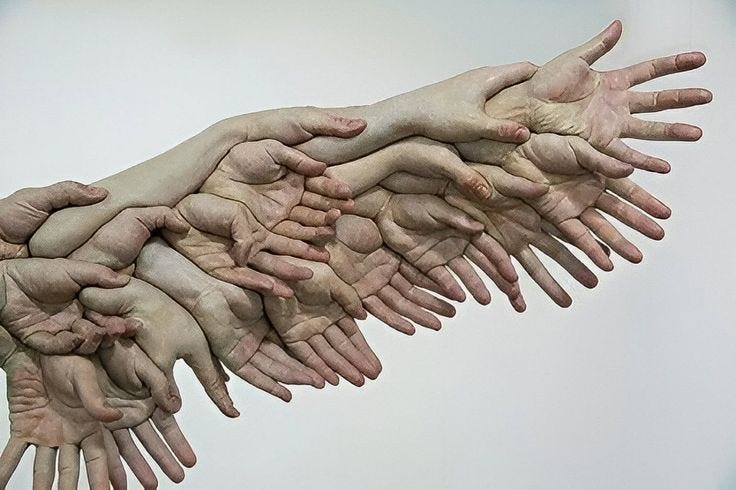
In the Zulu language of South Africa, there is a word that has no true counterpart in English: ubuntu. It translates loosely to I am because we are. More than a word, ubuntu is a condition of being, a philosophy. It’s the understanding that a person becomes a person through other people. It’s the recognition that a person does not exist in isolation, that our humanity is something continually reflected back through others. You are the mirror that teaches me who I am.
Ubuntu isn’t sainthood or self-erasure. It doesn’t ask you to give until nothing is left. It isn’t politeness, or martyrdom disguised as care. It’s knowing that what lives in me lives in you; that our joys and wounds are not separate territories. To live with ubuntu is to move through the world with that understanding. What I do to you, I do to myself.
I’ve seen it in action a handful of times in Ghana. Once, in Wulugu, a man walked toward me and three other volunteers with a machete. Clearly confused; his eyes unfocused, mumbling Mampruli to himself. Before any of us could even register fear, ten others who had been standing around moved to us as soon as he raised his machete, immediately surrounding him and guiding him away. Another time, at the market, someone tried to pickpocket one of the volunteers. Again, before we understood what was happening, people nearby called out, warning us, scolding the thief. There was no question of whose problem it was. Everyone’s, apparently. The body moved as one.
It’s not like I had never experienced acts of goodness or collective action back home. And it’s not like every Ghanaian person was born with some innate moral purity. But I remember thinking that kindness there wasn’t a performance of virtue; it was simply the logic of being alive together. When survival is communal, kindness becomes less moralized and more necessary. It’s not charity, but maintenance; a form of collective hygiene that keeps the world in working order.
The Western myth of selfhood is a lonely one. It often tells us that strength is standing alone. Success can mean stepping over someone else’s body to reach the next rung. The tide that once carried us toward each other now pulls us apart. Capitalism increasingly teaches us to optimize the self, not the collective; to win, not to tend. Even goodness becomes transactional. We talk about empathy as a skill now, as if the soul needs a business case or as if kindness only counts when it yields a return.

All of this denies our bodily reality which is wired for connection. Neuroscience has begun to confirm what ubuntu has always implied: the borders where I end and you begin are not as clear as we think. When we witness another person’s pain, the same regions that register pain in our own bodies get activated: the anterior insula, the anterior cingulate, parts of the premotor cortex that mirror what we see. The body rehearses another’s suffering just enough to feel it. That’s why we flinch when we see someone getting hurt, or tear up when another cries. It’s not sentimentality; it’s circuitry. The brain was never meant to draw a hard border between your pain and mine.
Neuroscience has also shown that generosity and altruism don’t just make others feel good; they change the giver too. Acts of kindness trigger activity in the mesolimbic reward system, the same circuitry activated by food, music, or romantic love. The brain releases dopamine, endorphins, and oxytocin, creating a sense of warmth and calm that researchers call the helper’s high. The parasympathetic system steadies the heart, breathing deepens, and stress hormones fall. Evolution carved pleasure into generosity, and it shows us that what’s good for the group is good for the self.
This drive toward connection isn’t even limited to humans. In a study at the University of Chicago, researchers placed one rat in a transparent restrainer while another was free to roam the enclosure. Without any training or reward, the free rat learned how to open the door, and did so repeatedly, freeing its cage-mate even when food was available instead, even when the two couldn’t directly interact afterward. When chocolate chips were introduced, the free rat would share them, saving at least one chip for the rat it had released. The scientists concluded that the behavior was driven by empathic concern, not conditioning. Even a rat, it seems, recognizes that freedom means little if it’s yours alone.
In the end, connection is our oldest inheritance. Long before we had words for compassion, the body was practicing it through its wiring. To help is to steady the pulse, to ease another’s pain is to quiet your own. Empathy has been a thing since before philosophy named it or religion sanctified it. It isn’t some higher virtue, but an ancient reflex, as natural and essential for survival as breathing.
To live with ubuntu, then, is simply to remember what the body already knows: that we survive by each other’s grace. I keep thinking I’m a single body walking through a single life. But then I catch myself in the mirror and see my father’s eyes, and recognize the way my brother laughs in mine. I, like everyone else, am woven from borrowed gestures.
The water keeps moving. What you give leaves you, but not the world. It finds another shore, another body, and returns carrying fingerprints that are not your own. Every gesture writes itself into the current, every kindness changes the wave, every cruelty leaves a bruise we all feel. What I do to you, I do to myself. The tide remembers. Beneath the surface, pulse to pulse, we keep remaking one another. We keep breathing each other’s air. Nothing moves alone. When I forget, remind me. When I harden, reach for me. I am because we are.
Beautiful beautiful beautiful!
I loved this one! So powerful yet so true.